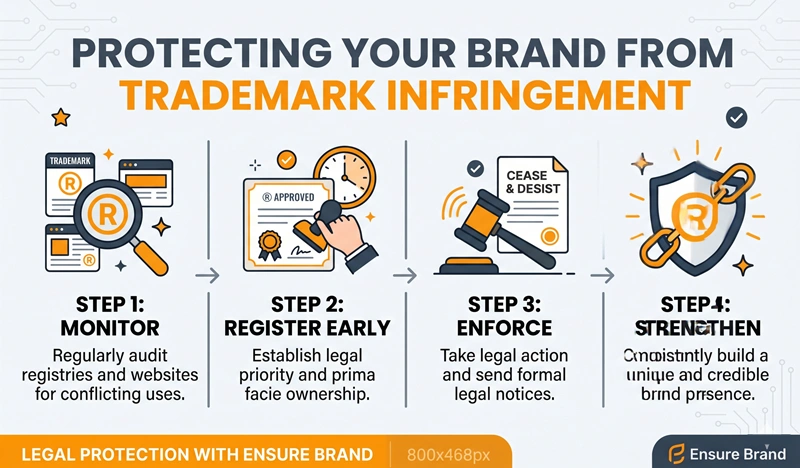
How to Protect Your Brand from Trademark Infringement
Building a reputable brand takes years of hard work, consistent quality, and strategic marketing. However, as your business grows and gains traction in the market, it also catches the attention of copycats, counterfeiters, and unethical competitors. If someone starts using a strikingly similar name, logo, or tagline to siphon away your hard-earned customers, your business sustainability is directly compromised.
To secure your market share, you must establish defensive protocols. Dealing with bad faith actors requires quick execution and proper knowledge of intellectual property rights. Let’s explore how you can tackle trademark infringement effectively and set up absolute legal defenses for your enterprise.
What is Trademark Infringement?
In simple terms, trademark infringement occurs when an unauthorized party uses a trademark that is identical or deceptively similar to a pre-existing registered trademark. The legal core of infringement rests on the **”likelihood of confusion”** among ordinary consumers.
If a competitor’s brand assets mislead customers into believing that their low-grade goods or services are manufactured by, affiliated with, or endorsed by your premium brand, it constitutes a clear legal violation under the Trade Marks Act, 1999.
Common Examples of Brand Misuse
Infringement isn’t always an exact carbon copy of your business; it often takes subtle, deceptive forms to exploit loophole pathways. Common patterns include:
- Phonetic Similarity: Using names that sound exactly like yours when spoken aloud (e.g., trying to register “Koka-Kola” or “Nikee”).
- Cybersquatting & Domain Mimicry: Registering website URLs that mimic your actual domain name to intercept organic web search traffic.
- Logo Alteration: Copying your brand’s specific color combinations, structural geometry, or layout fonts while modifying minor details to trick buyers.
- Meta-Tag & Keyword Manipulation: Competitors using your trademarked corporate name inside their hidden website keywords or paid search ads to rank for your brand name.
How to Actively Monitor Your Brand
The government does not actively police the market on your behalf. It is entirely the brand owner’s responsibility to detect and report violations. To keep copycats at bay, establish a continuous monitoring routine:
- Review the Trade Marks Journal: The Indian IP Office publishes a weekly journal displaying newly filed applications. Regularly auditing this helps you spot conflicting applications early enough to file an official opposition within the statutory 4-month window.
- Set Up Web Alerts: Use automated digital tracking tools and web monitoring triggers to instantly know when your brand name or variations are mentioned on forums, blogs, or new domains.
- E-Commerce Marketplace Audits: If you run a product business, routinely audit major retail apps (Amazon, Flipkart, etc.) for unauthorized third-party merchants selling counterfeits using your product listings.
Legal Actions Against Infringement
When you catch an infringer, you possess multiple layers of **trademark legal protection** to halt their operations and claim damages:
| Legal Remedy | Action and Enforcement Mechanism |
|---|---|
| Cease & Desist Notice | A formal legal notice sent via legal experts demanding the immediate cessation of illegal brand use. |
| Injunction Orders | A court order that forces the infringing business to completely stop using your name/logo while the lawsuit is ongoing. |
| Damages & Profits | The court can order the infringer to pay financial compensation or hand over all profits made through your brand identity. |
| Criminal Action | In severe counterfeit scenarios, police raids and seizures of illicit goods can be initiated under court warrants. |
⭐ Tips to Strengthen Your Brand Protection
- Register Early: Do not wait for your brand to become massive. Secure your trademark registration right at the launch stage to establish legal priority.
- File Across Multiple Classes: If your company expands into auxiliary sectors, file defensive applications in those specific trademark classes to avoid containment.
- Enforce Consistent Guidelines: Always display the ® symbol next to your registered assets to put the public on official notice that your properties are legally bound.
- Never Ignore Minor Violations: Tolerating small copycats dilutes your mark’s uniqueness over time, weakening your standing in a major court trial later.
The Absolute Importance of Trademark Registration
If you operate a business without an official registration certificate, fighting copycats is a brutal uphill battle. Unregistered brands must rely on common-law **”Passing Off”** actions, which require massive evidentiary proof of market reputation, huge financial expenses, and prolonged legal struggles.
A registered trademark skips these structural bottlenecks completely, providing prima facie proof of ownership in court and giving you immediate access to rapid anti-infringement laws.
This is why picking dedicated **brand protection services** matters. At Ensure, we assist businesses by continuously auditing industrial registries, tracking malicious applications, and drafting powerful litigation or defense responses to insulate your brand’s commercial future.
Stop Copycats From Damaging Your Brand!
Is someone copying your business name or logo? Don’t leave your reputation vulnerable. Reach out to our legal experts right away.

Connect on WhatsApp