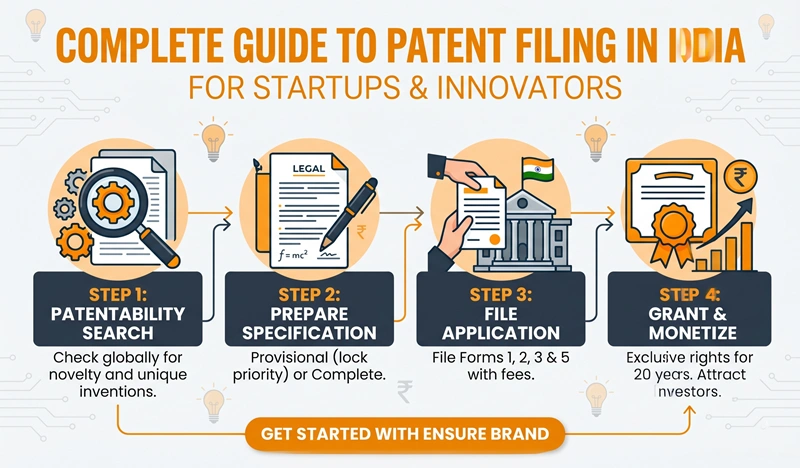
Complete Guide to Patent Filing in India for Startups and Innovators
In today’s highly competitive business landscape, an idea can change the world—but only if it belongs exclusively to you. For startups, tech disruptors, and individual inventors, a breakthrough invention is often the most valuable asset the company owns. Without a strong legal shield, your hard work, research, and capital investment can be replicated by larger competitors in a flash.
Securing your unique invention requires deep legal planning. This is where Patent Filing in India becomes a game-changer. In this comprehensive guide, we walk you through the structural blueprint of the patent lifecycle, helping you turn your creative concepts into powerful, legally protected business assets.
What is a Patent?
A patent is an exclusive legal right granted by the Government of India to an inventor for a specific invention. It gives the patent holder total market exclusivity to make, use, sell, or import the invention for a maximum period of 20 years. In exchange for this monopoly, the inventor must publicly disclose the technical details of the invention.
However, not every thought or simple modification can be patented. Under the Indian Patents Act 1970, an invention must fulfill three strict baseline criteria:
- Novelty: The invention must be completely new and cannot have been published or disclosed anywhere in the world prior to the filing date.
- Inventive Step (Non-Obviousness): The technology must feature a technical advancement that is not obvious to a person skilled in that specific technical field.
- Industrial Applicability: The invention must possess practical utility and be capable of being manufactured or used in an actual industry.
Who Can Apply for a Patent in India?
The Indian patent ecosystem is highly inclusive, designed to support innovators at all operational scales. According to the regulations, an application for a patent for an invention may be made by any of the following entities:
- The True and First Inventor: The original creative mastermind or team behind the technology.
- The Assignee of the Inventor: A company, research institution, or individual to whom the inventor has legally transferred or sold their rights.
- Legal Representatives: In the unfortunate event of an inventor’s demise, their legal heir or representative can file on their behalf.
Special Startup Status: To boost local tech development, the government offers deep fee concessions and fast-tracked examination channels specifically for registered entities under the **Startup Patent Protection** scheme.
The Comprehensive Patent Registration Process Explained
The journey from a laboratory concept to a granted patent certificate involves navigating a systematic multi-stage framework. Here is a granular breakdown of the patent registration process:
Before drafting any legal paperwork, an exhaustive global search across patent databases (USPTO, EPO, WIPO, IP India) and non-patent literature is conducted to ensure your creation does not overlap with pre-existing technology.
A legal-technical document is written detailing the operation of the invention. If your technology is still in development, you can file a Provisional Specification to lock in an early priority date. A Complete Specification must then be submitted within 12 months.
The formal application forms along with prescribed fees are uploaded via the official e-filing portal of the Indian Patent Office.
The application is automatically published in the official Patent Office Journal 18 months after the filing or priority date. Inventors can also file an early publication request to speed up this timeline to less than a month.
The patent office will not review your file automatically. A formal Request for Examination must be submitted within 48 months from the filing date to initiate the evaluation.
An official examiner reviews the technology and issues a First Examination Report containing any objections. A well-constructed response must be filed to clear objections, after which the patent is officially granted.
Mandatory Documents Required for Filing
| Statutory Form | Description & Scope |
|---|---|
| Form 1 | The official Application for Grant of Patent containing basic developer details. |
| Form 2 | Provisional or Complete Patent Specification documents including structural claims. |
| Form 3 | Statement and undertaking regarding foreign patent applications for the same idea. |
| Form 5 | Declaration of true and original inventorship from the creators. |
Strategic Benefits of Patent Protection for Startups
Securing early patent rights provides immense commercial leverage that helps scale operations safely:
- Attracts Venture Capitalists: Investors prioritize funding startups that hold a proprietary tech moat. A patent serves as physical proof of your technological edge.
- Monetization & Passive Royalty Channels: You don’t have to manufacture everything yourself. You can license your patent rights to corporations in exchange for substantial recurring royalties.
- Market Dominance: It gives your startup a legal shield to prevent any firm from undercuting your prices with copied models.
🛑 Common Patent Filing Mistakes to Avoid
- Publicly Disclosing Before Filing: Presenting your idea at college fests, tech expos, or online articles before filing completely destroys its “Novelty” factor, making it un-patentable.
- Vague Claims Drafting: The “Claims” section defines the exact boundary of your legal defense. Poorly written, overly broad, or narrow claims allow competitors to easily bypass your patent.
- Missing Statutory Deadlines: Failing to submit a complete specification within 12 months of your provisional filing leads to your application being permanently abandoned.
Why Professional Assistance Matters
Patent documentation is vastly different from standard corporate registration. It requires an advanced blend of deep engineering knowledge and techno-legal expertise to construct claims that survive legal scrutiny. A single flawed word can render an entire patent useless.
At Ensure, our dedicated network of patent attorneys and domain experts simplify the complex pathways of intellectual property management, guiding your innovations from conceptual drafts straight to final certification.
Secure Your Innovation Moat Today!
Don’t leave your proprietary technology vulnerable to replication. Speak to our legal experts today to fast-track your Patent filing.

Connect on WhatsApp